Jacob Discovers the Cairnholm Time Loop
Miss Peregrine's Home of Peculiar ChildrenJacob Discovers the Cairnholm Time Loop is the turning point at which Jacob Portman’s investigation of his grandfather’s last words becomes a direct encounter with the impossible: a stone tomb on Cairnholm opens onto September 3, 1940, a day that repeats. The discovery transforms Jacob’s apparent pursuit of a hallucination into entry into the world of Emma Bloom, Millard Nullings, and Miss Peregrine, while revealing that the loop’s protection comes at the cost of ordinary historical time.
From pursuit to doubt
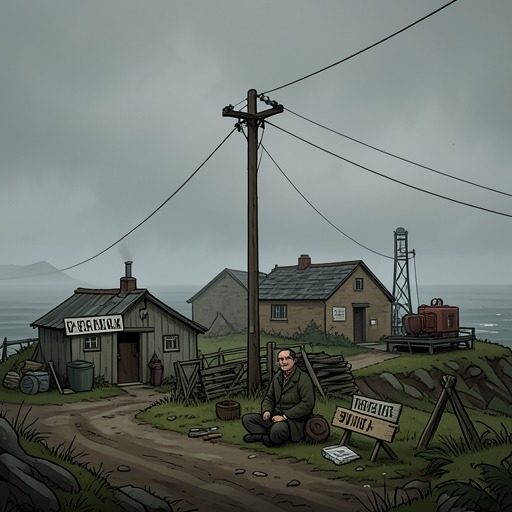
Jacob’s route to the cairn begins in the fog-bound bog, where he follows the footprints of a girl he believes he has seen. The ground repeatedly gives way beneath him, and the mist closes off his view of the path. Her tracks lead not back toward safety but to a mound of stones: a Neolithic tomb, one of the cairns that gave Cairnholm its name. Narrow and long, with a rectangular entrance and carved loops and spirals whose meanings have been lost, it rises from a patch of firmer ground in the bog.
Jacob enters because he thinks the girl is ahead. The passage is damp, dark, and so cramped that he must move hunched over; at its end, however, he finds only an empty chamber about the size of his bedroom. There he revises his understanding of what has happened. He decides that there was no girl and that his mind had conjured her and the other children while he was looking at their photographs. He attributes the abrupt darkness that came before their appearance to a blackout, and recalls the explanation his psychiatrist, Dr. Golan, might give: that being in the emotionally charged house had triggered a stress reaction.
The change in Jacob’s interpretation is initially a retreat from mystery. Humiliated, he crawls back through the tunnel and decides he wants to go home. He no longer cares about the photographs or his grandfather’s riddles and last words; pursuing them, he thinks, has made him worse rather than better. The empty chamber seems to confirm that he has been chasing an illusion.
The other side of the cairn
When Jacob leaves the tomb, the familiar bog appears transformed, though its basic landmarks remain. The fog has lifted, the sky is blue, and the weather feels like midsummer rather than the cool, wet June he has known since arriving. The path has dried rapidly, but animal droppings cover it; back in town, Jacob notices that horses and mules pull carts where tractors had been. These mismatches make the island feel familiar in place but unfamiliar in time.
The decisive clue is a calendar showing a tropical beach scene and the heading “September 1940.” The first two days are crossed out. Jacob connects the date with the remembered instruction from his grandfather, Abraham Portman: find the bird in the loop, on the other side of the old man’s grave. The “Old Man,” he realizes, is the name islanders give the bog body; its grave is the cairn. Jacob has gone inside the tomb and come out somewhere else: September 3, 1940. As he completes the deduction, his knees give way and the room fades into darkness.
The discovery also recontextualizes the island’s archaeological past. The body known locally as the Old Man, or Cairnholm Man, is more than 2,700 years old, though he was sixteen when he died. It was found by turf cutters digging for peat near the large stone cairn in the 1970s. The bog’s conditions preserved the body; the cairn is therefore both a grave associated with the island’s distant past and the threshold through which Jacob reaches a repeating day in its more recent history.
Meeting the loop’s inhabitants
After waking with his hands tied to a cooking range, Jacob hears Emma and Millard discuss how he could know about events they have already experienced. Millard explains that those events happened yesterday and the day before, “in your loop”; Emma rejects the suggestion that Jacob belongs to their world and suspects he is a wight. Their disagreement makes clear that Jacob’s arrival is not yet understood as harmless or ordinary. He insists that he is Jacob, but Emma remains wary.
Emma and Millard take Jacob away from the town by wagon and then on foot through the woods. The landscape ahead contradicts the ruined house Jacob remembers: the path is clear, the gardens are orderly, and the house stands intact, with its turrets and chimneys restored. The difference is not simply a change of weather or a better-preserved building; Jacob has crossed into the children’s time and place.
From a window, he sees children he recognizes from his grandfather’s yellowed photographs playing among flowerbeds. A girl who appeared to float in the pictures first walks with effort and then rises into the air when two boys hold a rope around her waist. What had seemed to Jacob like an impossible image in an old photograph is now a witnessed ability, performed in the house’s garden. The scene gives concrete form to the enchanted refuge Abraham had described, and Jacob no longer wants to wake from what he had feared might be a dream.
Emma brings him before the headmistress, Miss Peregrine, who is knitting in a sunlit sitting room. Dressed in black, with her hair pinned into a neat knot, she recognizes Jacob and addresses him by name before Emma can explain who he is. Miss Peregrine’s composed reception marks a shift from the children’s suspicion to a formal encounter with the person who can explain the place Jacob has entered.
What the repeated day means
Miss Peregrine identifies the place as a loop and names its date: the third of September, 1940. The day repeats “over and over,” she explains, while the residents experience their lives as continuous and remember the decades spent there. The calendar’s date is thus not a historical marker that simply places Jacob in the past. It identifies the recurring day in which the inhabitants’ daily surroundings reset while their personal memories accumulate.
The loop is part of the work of ymbrynes, women who can manipulate time fields for themselves and others. Miss Peregrine explains that they create temporal loops in which peculiar people can live indefinitely. Their responsibilities include finding young peculiars in need, protecting them from danger, and providing for them, as well as ensuring that the loops reset regularly. The loop’s apparent stillness is maintained through deliberate care, not by an automatic suspension of all change.
Miss Peregrine describes the entry point as something that must be crossed periodically to keep it pliable. Without ingress or egress, the loop can become unstable as pressures accrue in a closed temporal system. She compares the opening to a hole in fresh dough that may close if it is not entered from time to time, and gestures to suggest what could happen if the system lost its outlet. Jacob’s passage through the cairn therefore exposes both the loop’s access point and the maintenance rule on which its continued existence depends.
Shelter, limitation, and the return of time
The loop’s safety has a psychological as well as temporal dimension. While waiting in the garden for Emma, Jacob finds himself becoming drowsy and serenely content. He reflects that the place’s beauty seems almost narcotic: if its pleasantness keeps residents from wanting to leave, the refuge may also function as a prison. The children can live through the same day for decades, but that continuity separates them from the changing world beyond the loop and narrows their prospects for an ordinary future.
The distinction becomes sharper when Jacob later learns about leapfrogging between loops. Millard describes it as a dangerous, complex way of moving from one loop to another, potentially opening access to loops that have ceased to exist in the intervening years. That possibility suggests that loops are not isolated repetitions without relation to history; they form an intricate geography of accessible times, though reaching those times carries risk.
When the children eventually leave the damaged house and the loop, the contrast with Jacob’s first discovery reaches its consequence. On September 4, for the first time in a very long time, the days are moving again. The children feel more vital and real, and Jacob does too. The date that first revealed the loop as a sealed repetition becomes the threshold to renewed passage through time. Jacob’s discovery thus introduces the loop as both refuge and constraint: a carefully maintained world of remembered decades held inside one recurring day, from which departure restores the movement of history.